
There is a difference between practising and playing, and a lot of musicians don't know which one they're doing.
Playing is picking up your guitar and running through songs you already know. Playing is noodling in a familiar scale. Playing is fun, comfortable, and easy. Playing makes you feel like a musician.
Practising is different. Practising can be uncomfortable. Practising means working on the thing you can't do. It means slowing down until every note is clean. It means hearing all of your mistakes. Practising does not always feel like progress, and a lot of times it feels like you're going backwards, but it's the thing that produces results.
Both of these are valuable.
The comfort zone trap
Our brains are wired for comfort. When you pick up your instrument without a plan, you will naturally play things you already know and enjoy, and are probably pretty good at. This feels good because you are making music. But you aren't building anything new.
Building new skills happens at the edge of your ability. Not deep in unfamiliar territory where everything falls apart (although that's a great place to be too!), and not safely inside what you've already mastered. Find the boundary where you can almost do it. This is where new paths through the wilderness are found, and neural pathways are formed.
The problem is that this zone is uncomfortable by definition. Your fingers fumble. The tempo is slow. You sound bad. It's not pretty.
But hey, if it was easy everyone would do it. Focused practice means staying in the discomfort zone on purpose.
How focus changes everything
Picture two guitarists who both spend twenty minutes practicing today.
Guitarist A opens YouTube and plays along with Sweet Child O' Mine, their favourite song. They sound okay, couple of flubs but nothing major. They feel good. They're done.
Guitarist B sets a slow metronome and plays a finger pattern they have been struggling with. It sounds clunky. They slow it down more, and painfully repeat the pattern over and over. By the end of twenty minutes, it may not perfect but it's been worked into the fingers and the brain, they know exactly what is tripping them up and how to work on it.
Guitarist A had a good time. Guitarist B improved. In a couple of days, guitarist B will be way better at that pattern. In a week or two it will be automatic, and they will be working on something new. Guitarist A will be in exactly the same place.
The difference is not talent or time. It's focus. Guitarist B set their intention, eliminated distractions, and worked on that one thing. That is the entire secret.
Repetition doesn't mean boring.
There is a reason every great musician talks about repetition. Coltrane practised the same passages for hours. Classical pianists play the same measure hundreds of times in a single sitting.
Repetition is not a failure of creativity. It is how your nervous system converts conscious effort into automatic skill. The first time you play a difficult riff, your brain is working overtime — coordinating fingers, rhythm, finding the frets. The fiftieth time, most of that processing has been offloaded to muscle memory. The hundredth time, your conscious mind is free to focus on dynamics, feel, tone and expression.
You can't shortcut the process, but you can make faster progress. Mindless repetition, playing the same thing over and over while your thoughts wander, is almost worthless (although everything has it's place). Attentive repetition is where the magic happens.
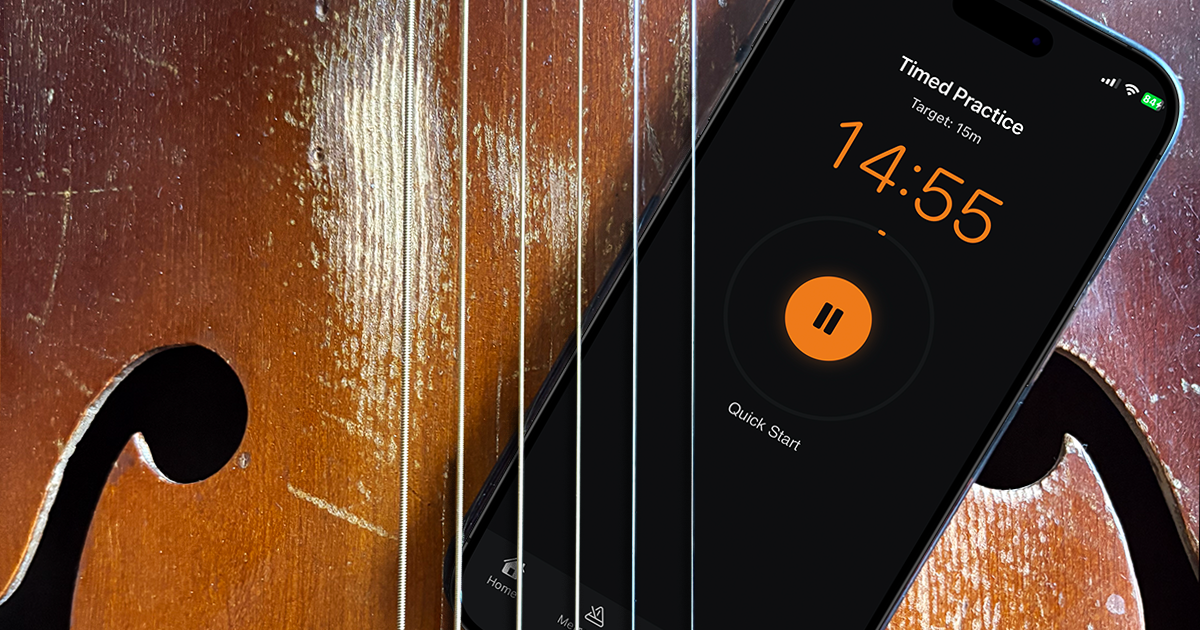
This is why a timer is helpful, it creates a window for repetition.
Track it or lose it
One of the most powerful things you can do is track what you practise, not just how long you practise.
When you log your sessions with the specific practice type — scales, rhythm, technique, a particular song — you build a picture over time. You can see that you have spent two weeks on rhythm exercises and zero time on theory. You can see that your best-rated sessions tend to happen in the morning. You can see that you always skip Wednesdays.
This data turns vague feelings into concrete patterns. And concrete patterns are what you need to make better decisions about where to focus next.
Progress tracking also solves the motivation problem. When you can't hear improvement day to day, and a lot of times you might not, because improvement is gradual, your practice log provides the evidence. Seven consecutive days. Fifteen sessions this month. Total time up twenty percent from last month. This can help remind you that the work is working, even when it feels like you're spinning your wheels.
Practicing or playing?
Next time you sit down with your instrument, ask yourself one question before you start: am I practising or playing?
If you are practising, set a timer, pick a target, and commit. When the timer ends, you are done with the hard part.
If you are playing, let it breathe with the open clock running. Enjoy it.
That awareness alone will change your trajectory.